Hi folks,
here are the 10 AI tech and business news stories that I found most interesting since the start of the year.
#1 Meta’s Massive Infrastructure Bet
Meta is scaling its data center capacity to reach « Gigawatt-scale » and achieve Personal Superintelligence.
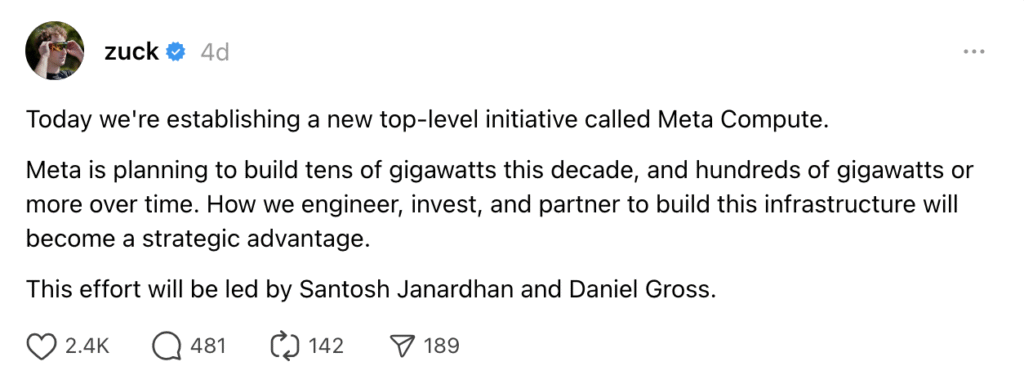
- Infrastructure Surge: Plans to deploy dozens of gigawatts this decade, aiming for hundreds of gigawatts in the long term.
- Massive Investment: Committed $600B in U.S. infrastructure spending through 2028.
- Nuclear Power: Locked in 20-year nuclear energy agreements to ensure sustainable and stable power for its AI roadmap.
👉 More details here
#2 Microsoft’s « Community-First » AI Infrastructure
A new approach to data center deployment that prioritizes local community needs and sustainability.
- Social Impact: Aims to minimize environmental footprints (water/energy) while maximizing local benefits.
- 5 Key Commitments: Affordable/responsible electricity, sustainable water management, local job creation, local tax contributions, and AI education funding.
👉 More details here
#3 Anthropic Launches « Claude Cowork »
Claude evolves from a chatbot into an agentic « digital collaborator » capable of executing complex tasks.
- Autonomous Mode: An agentic feature for Claude Desktop (macOS) available for Claude Max subscribers.
- Rapid Development: Built in just 1.5 weeks using Anthropic’s own agentic coding tools.
- Key Capabilities: Direct file access (read/write), multi-step execution without intervention, and automated document/report generation.
👉 More details here
#4 Slackbot: The Context-Aware Assistant
Slack transforms its integrated bot into a high-context AI agent for the enterprise.
- Workplace Integration: Operates directly within Slack channels and threads.
- Deep Context: Leverages internal conversations, files, and project history to provide personalized support.
👉 More details here
#5 Nvidia & Groq: A $20 Billion Strategic Move
Nvidia secures a massive deal with chip startup Groq to strengthen its hardware dominance.
- Tech Licensing: Includes a technology license and a significant transfer of specialized engineering teams.
- Competitive Edge: Highlights the intense race for AI inference hardware and specialized chip architectures.
👉 More details here
#6 Google Introduces Universal Commerce Protocol (UCP)
A new open-source standard designed to enable seamless « Agentic Commerce. »
- Unified Language: Creates a common protocol between AI agents, e-commerce platforms, and payment providers (Visa, PayPal, Google Pay).
- Seamless Shopping: Allows AI agents (like Gemini) to search, compare, and complete purchases automatically.
👉 More details here
#7 The 7-Month Doubling Rule
Global AI compute capacity is growing at an unprecedented rate, doubling every 7 months.
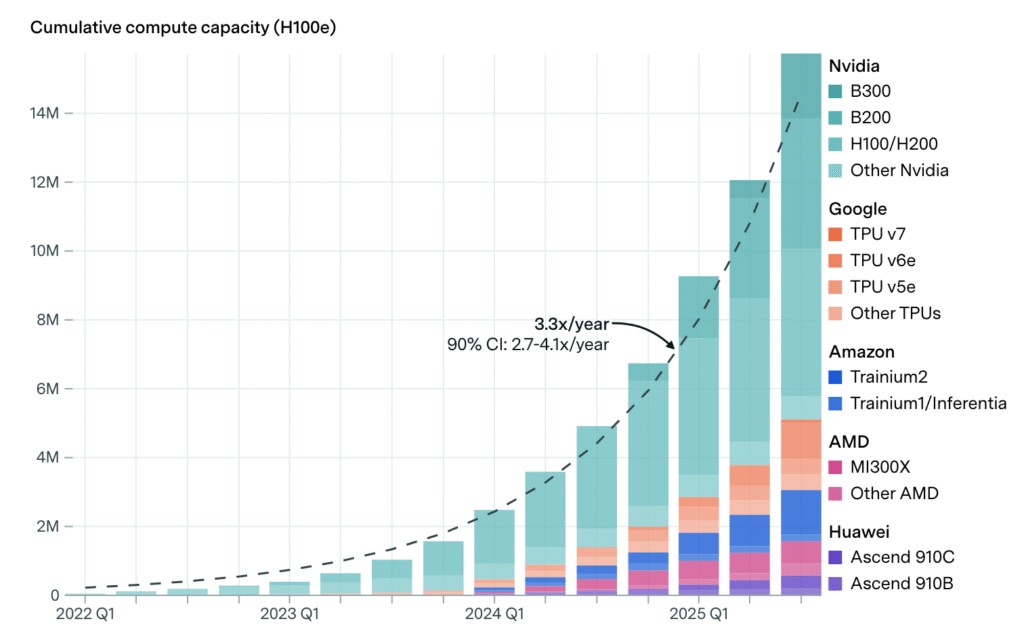
- Exponential Growth: Total available compute has increased 3.3x per year since 2022.
- Market Share: Nvidia dominates with over 60% of global capacity, followed by custom chips from Google (TPU) and Amazon (Trainium).
👉 More details here
#8 Amazon Launches Alexa+ for the Web
Amazon’s AI-powered assistant moves beyond smart speakers to directly challenge ChatGPT and Claude.
- Web-First Interface: Alexa.com now offers a browser-based chatbot for research and planning.
- Third-Party Agents: Partnered with Expedia, Yelp, and Uber for autonomous booking and services.
- Usage Surge: Engagement reportedly increased 3-5x since the AI-infused « Alexa+ » rollout.
👉 More details here
#9 Nvidia’s « Alpamayo »: The ChatGPT Moment for Physical AI
Announced at CES 2026, Alpamayo brings real-time reasoning to autonomous vehicles.
- VLA Model: A 10B parameter Vision-Language-Action model that « reasons » through complex driving scenarios.
- AlpaSim: An open simulation framework to refine driving logic in realistic virtual environments.
- Open Data: Release of massive physical AI datasets to accelerate industry-wide development.
👉 More details here
# 10 Pro Tips: Engineering at Scale with Claude Code
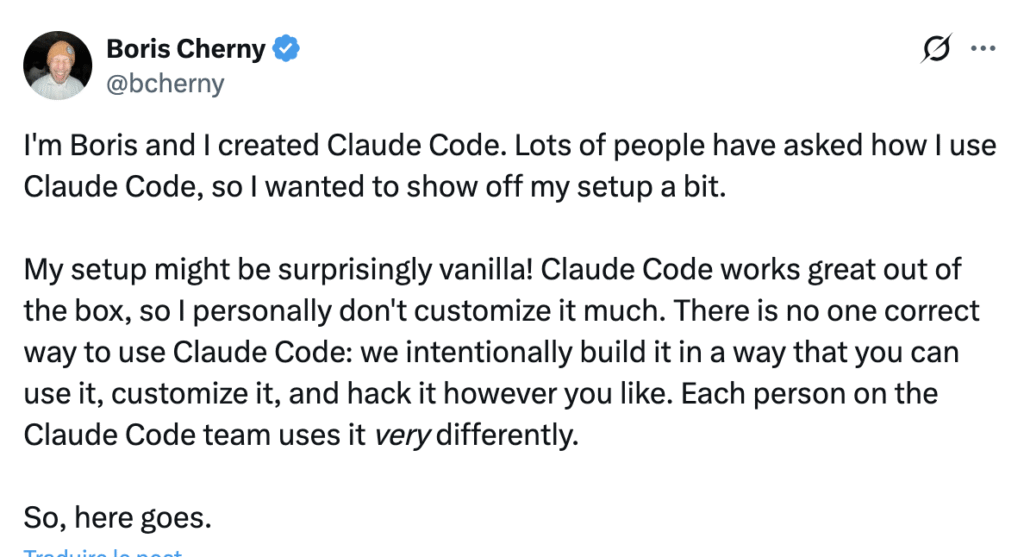
Anthropic’s Boris Cherny reveals how the pros use agentic coding tools.
- Parallelization: Running up to 15 Claude sessions simultaneously for different sub-tasks.
- Institutional Memory: Using a CLAUDE.md file to turn past mistakes into permanent instructions.
- Sub-agents: Treating sub-agents as « reusable workflow atoms » to automate repetitive dev cycles.
👉 More details here
That’s it for this time, have a good week-end!